Write Yourself Back to Calm: 10-Minute Journal Routine

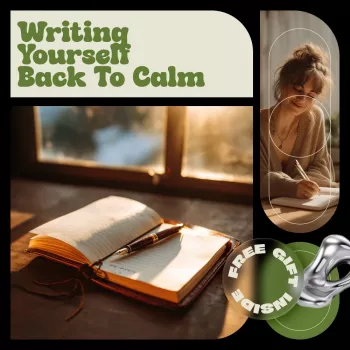
Writing Yourself Back to Calm: A Practical Journaling Mindfulness Routine for Stress Relief and Emotional Clarity
Stress often shows up as racing thoughts, tight shoulders, and a feeling of being mentally “stuck.” A simple journaling mindfulness routine can slow the spiral by giving thoughts a safe place to land, helping emotions become clearer and more manageable. This guide offers a gentle, repeatable approach—short enough for busy days, structured enough to feel supportive—so daily reflection becomes a steady path back to calm.
What “writing back to calm” means
“Writing back to calm” is less about solving everything and more about shifting from mental noise to grounded awareness. When your thoughts are looping, the page becomes a safe container: you can notice what’s happening, name it clearly, and release some of the pressure without demanding instant answers.
- Use writing as a transition from rumination to presence: notice, name, and release.
- Treat the page like a holding space for emotions—thoughts can exist without being fixed today.
- Aim for steadiness over perfection; a few minutes done consistently beats occasional long sessions.
- Pair reflection with mindful attention (breath, body sensations, sounds) to reduce spiraling.
For a quick, research-backed refresher on how stress affects mind and body, the American Psychological Association’s stress overview is a helpful starting point. For mindfulness basics and safety considerations, see the National Center for Complementary and Integrative Health.
Set up a 10-minute daily practice that actually fits real life
The most calming routine is the one you’ll actually repeat. Keep it simple, anchored to a cue you already have, and easy to “complete” even on messy days.
- Choose a consistent cue: after morning coffee, after lunch, or before sleep.
- Create a minimum version for hard days: 3 sentences or 3 bullets is enough.
- Keep tools friction-free: a dedicated journal, a pen that feels good, and a quiet corner.
- Close the practice with a grounding action: one slow breath, a stretch, or a sip of water.
10-minute journaling mindfulness flow
| Minute | Focus | Prompt or action |
|---|---|---|
| 1 | Arrive | Take 5 slow breaths; feel feet or seat supported. |
| 2–4 | Unload | Write the thoughts looping the loudest—no editing. |
| 5–7 | Name and soften | Label emotions (“anxious,” “sad,” “overwhelmed”) and note where felt in the body. |
| 8–9 | Reframe gently | Ask: “What would be a kinder, truer sentence right now?” |
| 10 | Close | Write one next step for today that is small and doable. |
Prompts for stress relief when the mind won’t slow down
When you’re overloaded, journaling works best as a pressure-release valve. Keep lines short, list-like, and concrete—your goal is to reduce the mental pileup.
- “Right now I’m carrying…” (list worries, tasks, expectations—one per line).
- “The part of me that feels stressed is trying to…” (protect, prepare, avoid, please).
- “If today could be 10% easier, I would…” (one adjustment, one boundary, one request).
- “What’s true in this moment?” (facts only, then feelings, then needs).
- “What can wait?” (move non-urgent items to a later list).
If you notice yourself speed-writing into more tension, pause and add one sensory anchor: feel your jaw unclench, relax your shoulders, and write one plain observation such as “I’m sitting in a chair and my feet are on the floor.”
Prompts for emotional clarity when feelings are mixed or confusing
Clarity often comes from precision. Instead of “I’m fine” or “I’m a mess,” aim for language that separates emotion, meaning, and need—without arguing with what you feel.
- Use a three-layer check-in: “I feel… because… and I need…” (no need to justify the need).
- Try “both/and” statements: “I’m disappointed and I’m proud I tried.”
- Identify triggers and tender spots: “This situation reminds me of…” (gently, without blame).
- Separate story from signal: write the narrative, then list the sensations and needs underneath.
- End with one compassionate sentence you’d say to a friend in the same situation.
This approach reduces emotional “static.” You’re not forcing positivity—you’re giving your nervous system a cleaner signal: what’s here, what it means, and what would help.
Daily reflection that strengthens calm over time
A 7-day reset plan using short, repeatable pages
Make the routine feel supported, not like another task
A guided option for consistent calm-building pages
If you prefer not to think about what to write each day, a ready-to-use format can help you show up consistently. The Writing Yourself Back to Calm – Journaling Mindfulness Guide for Stress Relief, Emotional Clarity & Daily Reflection is designed for quick sessions with calming check-ins, gentle reframes, and supportive daily structure.
To complement your writing practice with mindset tools, you can also pair your journal routine with Speak Success: Your Power Words Action Checklist for concise, repeatable language you can use when motivation dips. If you notice a pattern of getting in your own way under pressure, Break Free: Stop Self-Sabotage Today can help you identify common blocks and rebuild follow-through.
FAQ
How long should a calming journaling session be?
Five to fifteen minutes is plenty, especially if you practice most days. On hard days, use a minimum version—three lines or three bullets—to keep the habit supportive without adding pressure.
What if journaling makes anxiety feel stronger at first?
It can happen because writing brings emotions to the surface instead of avoiding them. Shorten the session, switch to factual observations, and add grounding (breath, feet on the floor, naming objects in the room); if distress feels intense or persistent, consider professional support.
Is it better to journal in the morning or at night?
Morning journaling can create clarity and intention before the day accelerates, while nighttime journaling can help you decompress and sleep more peacefully. The best choice is the time you can keep most consistently.






Leave a comment