Rolling Tennis Ball Hopper Cart: 150/180 + Swivel Wheels
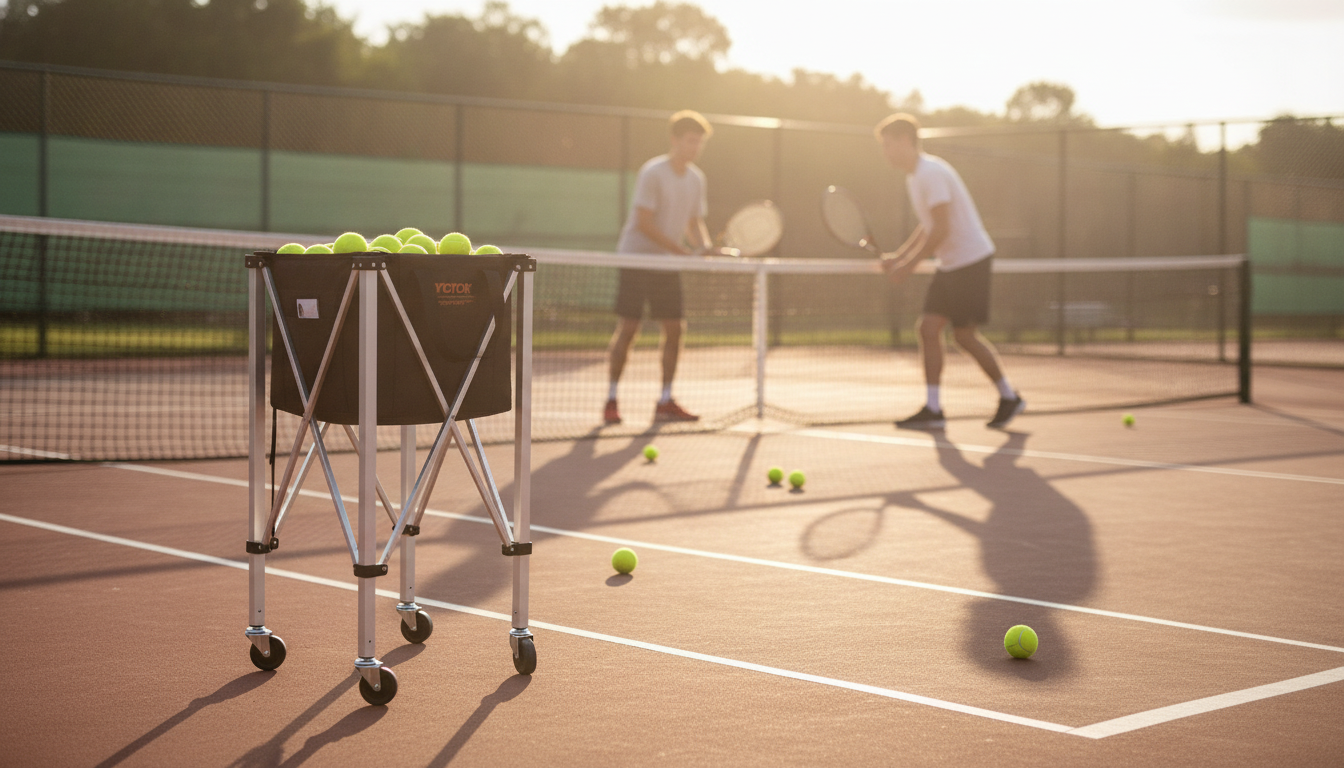
Portable Tennis Ball Hopper Cart with 360° Swivel Wheels – Holds 150/180 Balls
A rolling ball hopper cart can turn feeding drills and clean-up into a smooth, one-person routine. This portable tennis ball hopper cart combines high ball capacity with 360° swivel wheels for easy steering on court, plus a practical height for reducing repeated bending during practice. If training sessions involve lots of reps—serves, returns, approach patterns, or fast-paced clinics—a cart-style hopper helps keep the tempo up while taking some strain off your back and knees. For more guidance, see [PDF] Solar Tennis Ball Collector – UCF ECE – University of Central Florida.
What This Hopper Cart Is Designed to Solve
When practice runs well, the ball supply stays ahead of the drill. A high-capacity rolling hopper is built to keep that rhythm steady, especially during basket feeding and multi-ball progressions. For further reading, see Sturdy & Reliable Ball Hoppers & Baskets ~ Player’s Guide.
- Keeps practice moving by storing a large batch of balls for continuous feeding and rapid resets between drills
- Reduces time spent picking up balls by rolling alongside the court rather than carrying a basket
- Improves maneuverability with 360° swivel wheels for quick turns around baselines, ball machines, and benches
- Helps minimize repetitive bending with a cart-style format that can keep balls at a more reachable height
Capacity Options: 150 vs 180 Balls
Choosing between 150 and 180 balls is mostly about how long you want to go before refilling and how “heavy” you want the cart to feel when fully loaded. Both capacities support serious training blocks; the difference shows up most during high-volume feeding.
- Capacity affects how often refills are needed during high-rep sessions such as basket feeding, multi-ball drills, or group clinics
- A 150-ball load can be easier to manage for quick solo sessions while still supporting long drill blocks
- A 180-ball load suits longer practices, coaching environments, or players running extended consistency drills
- Consider total weight when fully loaded: more balls means more rolling resistance and slightly heavier handling when lifting or transporting
Capacity Planning at a Glance
| Scenario | Suggested Capacity | Why It Fits |
|---|---|---|
| Solo serving + baseline drills | 150 balls | Plenty for repeated patterns without a bulky load |
| Two-player feeding and return practice | 150–180 balls | Supports longer sequences before stopping to reload |
| Small group clinic | 180 balls | Reduces downtime and keeps lines moving |
| Coach-led high-volume multi-ball | 180 balls | Maximizes continuous feeding time |
Mobility: Why 360° Swivel Wheels Matter
Court movement during training isn’t just forward and back. Coaches and players constantly angle around the baseline, shift between deuce/ad sides, and thread through tight spaces near the fence or a ball machine. Swivel wheels are built for those frequent course corrections.
- Easier cornering and repositioning when moving between deuce/ad court, baseline, and service line
- Better control in tight areas near fences, benches, or ball machine setups
- Supports quick micro-adjustments during feeding without dragging or lifting the hopper
- Helpful for coaches who need to move continuously while monitoring footwork and contact points
On hard courts, swivel wheels help you pivot smoothly without wrestling the cart. On clay, keeping wheels free of grit can make the difference between “glides easily” and “feels sticky.” For broader context on court environments and standard play conditions, see the ITF Rules of Tennis.
Build and Practical Features to Look For
A hopper cart earns its place when it can handle daily use: rolling, stopping, turning, loading, unloading, and occasional bumps into benches or fence lines. The most useful details tend to be the simplest ones.
- Stable frame and a base that resists tipping when the cart is pushed or turned quickly
- Basket or cage structure that holds shape under heavy loads and frequent rolling
- Handles or grip points positioned for comfortable pushing at walking pace
- Openings that allow easy loading/unloading during drills without spilling balls
- Portable design that fits typical car trunks and can be moved from storage to court without hassle
Practice structure also matters. Well-designed feeding blocks reduce wasted motion and help players focus on patterns and decision-making. Training ideas and development frameworks can be found through USTA Player Development.
Best Use Cases: Who Benefits Most
Setup and Court Workflow Tips
Care, Storage, and Longevity
Product Snapshot
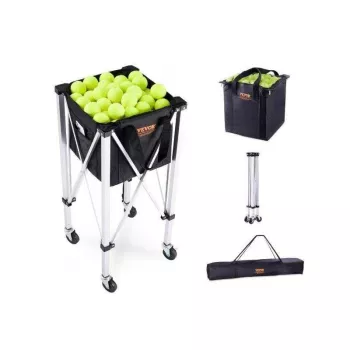
- Portable Tennis Ball Hopper Cart with 360° Swivel Wheels – Holds 150/180 Balls
- Designed for high-capacity practice sessions with easy rolling repositioning
- Suitable for players, coaches, and clinics that want quicker feeding and cleanup routines
- Mini 8GB Voice Recorder Digital Audio MP3 Player USB Pen with Earphones
- Speak Success: Your Power Words Action Checklist | Powerful Words for Success Daily Mindset Tool | Digital Download
- Break Free: Stop Self-Sabotage Today | How to Stop Self-Sabotage | Digital eBook for Mindset, Motivation & Lasting Personal Growth | Instant Download
FAQ
How many tennis balls does a hopper cart need to hold for practice?
For solo sessions and short-to-medium training blocks, 150 balls is usually plenty for repeated patterns without frequent refills. For clinics, multi-player drills, or high-rep feeding, 180 balls reduces downtime, but the cart will feel heavier and roll with slightly more resistance when fully loaded.
Do swivel wheels work well on tennis courts?
Yes—360° swivel wheels make it easier to turn tightly, reposition between deuce/ad sides, and maneuver near benches or ball machines. Keeping the wheels clear of grit or clay helps maintain smooth rolling and consistent steering.
Is a rolling hopper better than a carry basket?
A rolling hopper is often better for high-volume feeding because it reduces carrying, speeds up repositioning, and can cut down on repetitive bending. A carry basket can still be a good choice for ultra-compact transport or minimal-gear sessions where you don’t want to roll equipment.



Leave a comment