Quiet Your Inner Critic: 3-Step Reset for Self-Talk

Introduction
A harsh inner voice can sound like “You’re not good enough,” “You’ll mess it up,” or “Don’t even try.” The goal isn’t to force positivity or silence thoughts on command—it’s to understand what the inner critic is trying to do, reduce its intensity, and replace automatic self-attack with steadier, kinder self-coaching. This guide walks through simple ways to identify your critic’s patterns, interrupt spirals, and build emotional resilience with repeatable practices.
What the Inner Critic Really Is (and Why It Shows Up)
The inner critic usually isn’t “the real you.” It’s more like a strategy—often learned early—that tries to keep you safe or accepted. Common jobs it attempts include protecting you from rejection, preventing mistakes, pushing performance, and avoiding vulnerability. The problem is that it often uses shame, exaggeration, and all-or-nothing rules to do it.
Old experiences shape these “rules”: perfectionism (“If I’m flawless, I’m safe”), people-pleasing (“If everyone’s happy, I won’t be abandoned”), catastrophizing (“If I expect the worst, I’ll be prepared”), or constant self-comparison. And the critic typically gets louder during stress, fatigue, transitions, or when you’re comparing your behind-the-scenes to someone else’s highlight reel. The key reframe: the critic is an outdated protection reflex—not your identity.
Stress can also turn up the volume on threat responses in the body, making critical thoughts feel more urgent and believable. The American Psychological Association describes how stress affects the body and can intensify emotional reactivity (APA: Stress effects on the body).
Spotting the Patterns: Triggers, Themes, and Favorite Phrases
Change gets easier when you can predict your critic’s “script.” Start by noticing your top triggers: feedback (even gentle feedback), social situations, deadlines, body image moments, relationship uncertainty, money decisions, parenting pressure, or creative work where the outcome is visible.
Then look for recurring themes: “not enough,” “too much,” “they’ll judge,” “you’re behind,” “you should already know,” or “if you were smart you wouldn’t struggle.” Many people also notice distinct “voices” the critic uses:
- The judge: labels you (“lazy,” “selfish,” “dramatic”).
- The perfectionist: moves the finish line (“Not good enough yet.”).
- The mind-reader: assumes others’ negative thoughts without evidence.
- The catastrophizer: turns small risks into worst-case outcomes.
- The comparer: uses someone else’s life as the measuring stick.
A 3-Step Interrupt: Name It, Normalize It, Nudge It
1) Name it
2) Normalize it
3) Nudge it
Replace Self-Attack with Self-Coaching (Without Forced Positivity)
Inner Critic Reframe Examples
| Inner critic line | What it’s trying to protect | More helpful self-coaching response |
|---|---|---|
| “If it’s not perfect, it’s worthless.” | Avoiding judgment and shame | “Good enough gets done. I can revise after I ship a first draft.” |
| “You’ll embarrass yourself.” | Avoiding rejection | “It’s okay to be seen learning. I’ll prepare one step and show up anyway.” |
| “You’re behind everyone.” | Seeking certainty and safety | “Different timelines exist. I’ll focus on today’s next right step.” |
| “You always mess things up.” | Preventing future pain | “I’ve made mistakes and learned. What’s one adjustment for next time?” |
Daily Practices That Quiet the Critic Over Time
- Two-minute thought download: write the loudest self-judgments. Underline what’s factual vs. interpretive. Facts are usually shorter than the story.
- Micro-boundaries with the critic: “Not now—come back at 5 pm during review time.” This contains rumination so it doesn’t steal the whole day.
- Evidence collection: keep a short log of wins, kind actions, and times you coped well (not just achievements). This builds a more accurate self-image.
- Body-first regulation: sleep, food, movement, and breaks lower threat response and reduce critic intensity. If low mood is part of the picture, the NHS offers practical self-help ideas worth exploring (NHS: Self-help for low mood).
- Weekly review ritual: what worked, what didn’t, and one gentle goal for next week—focused on process, not perfection.
When the Critic Targets Relationships, Creativity, or Confidence
If your inner critic becomes relentless or feels tied to persistent anxiety or depressive symptoms, professional support can be a strong addition. The National Institute of Mental Health provides an overview of depression symptoms and when to seek help (NIMH: Depression overview and symptoms).
A Guided, Friendly Workbook-Style Option for Emotional Growth
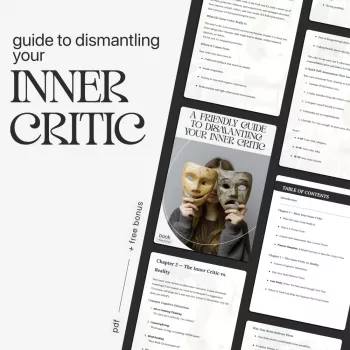
If you prefer a gentle, repeatable approach, consider A Friendly Guide to Dismantling Your Inner Critic (digital eBook) for guided prompts you can revisit quickly when the critic flares.
Some people also find it easier to hear coaching language out loud. You can record a short “calm script” (your 3-step interrupt plus one kind next step) and play it back during spirals using the Mini 8GB Voice Recorder Digital Audio MP3 Player USB Pen with Earphones. For longer audio practices, a dedicated device like the Bluetooth MP3 MP4 Player with 4.0″ Touchscreen can make it easier to keep supportive recordings handy without relying on constant phone scrolling.
FAQ
How do you stop negative self-talk when it feels automatic?
Use a short interrupt: label the critic, take one regulating breath, then replace global insults with specific, workable coaching language. Repeating the same script consistently helps it become your new default response.
Is the inner critic always a bad thing?
It often started as protection or motivation, but it becomes harmful when it relies on shame and exaggeration. The goal is to keep discernment while removing cruelty.
How long does it take to quiet the inner critic?
Many people feel small relief quickly with consistent interrupts, but deeper change usually comes from daily repetition over weeks—especially when paired with sleep, stress management, and supportive routines.






Leave a comment