How to Find a Profitable Niche: Validate Demand Fast

Finding Your First Profitable Niche (Without Guesswork)
A profitable niche lives at the overlap of a clearly defined audience, an urgent problem, and a proven willingness to spend money to fix it. Instead of betting on intuition, use a simple validation loop: generate ideas, narrow to one buyer, confirm demand with real-world signals, and pick a monetization path that fits your skills and budget. Done right, niche selection becomes a repeatable checklist—so you can move forward with evidence, not hope.
What a “profitable niche” actually looks like
“Fitness” is a topic. “New moms rebuilding core strength after birth” is a niche. Profitable niches tend to share a few traits:
- Specific buyer + specific problem: You can picture who they are and what they’re trying to solve.
- Clear outcomes people pay for: Saving time or money, reducing risk, improving health, increasing income, or boosting status.
- Repeatable demand: The problem shows up consistently in reviews, forums, and Q&A—not just during a short trend spike.
- Natural monetization path: Products, services, affiliate tools, ads, or digital downloads fit the problem without forcing it.
Step 1: Build a niche idea bank (without overthinking)
Start fast. Your goal is options, not perfection.
- Use three buckets: (1) your skills/experience, (2) persistent annoyances people complain about, (3) high-spend categories like health, finance, business, relationships, and home.
- Go “problem first”: Write: “People who struggle with ___ because ___,” and create 10–20 variations.
- Steal language from real buyers: Reviews and community posts reveal the exact words that later become your headlines and offers.
- Avoid idea traps: Overly broad topics, audiences with no purchasing power, and problems that happen once and never again.
Quick idea bank prompts
| Prompt | Example output |
|---|---|
| A group + a deadline | Remote workers preparing for a job interview in 14 days |
| A group + a constraint | College students eating high-protein on a tight budget |
| A tool + a result | Notion templates for freelancers tracking invoices |
| A mistake + a fix | New dog owners stopping leash pulling |
Step 2: Narrow to a buyer you can clearly describe
If your niche statement needs a paragraph, it’s still too wide. Aim for one sentence: who they are, what they want, and what’s blocking them.
- Add context qualifiers: Life stage, location, budget level, time constraints, or experience level. (Example: “first-time freelance designers who need clients in 30 days without paid ads.”)
- Look for consistent language: When people describe the same problem in similar terms, it becomes much easier to craft a clear offer.
- Check accessibility: You should be able to find the audience in obvious places—communities, newsletters, social channels, marketplaces, and search—without expensive gatekeepers.
Step 3: Validate demand using proof, not vibes
Validation is about spotting reliable signals that buyers are already paying for solutions. A few fast ways to do that:
- Marketplace proof: Look for bestsellers and steady review activity in relevant categories (books, courses, tools, templates). Consistent reviews usually beat one viral hit.
- Search and content proof: Repeated “how do I…,” “best ___ for ___,” and “___ vs ___” patterns show active problem-solving behavior. Google’s guidance on how people search can help you think in terms of real questions and tasks (Google Search Central).
- Community proof: Follow-up questions, “what worked for you?” threads, and recommendation requests are strong buying signals.
- Competitor proof: Competition isn’t a danger sign—it’s a receipt. The goal is clear positioning, not an empty market.
For trend vs. steady demand, a quick check on Google Trends can help you avoid niches that spike and disappear.
Validation checklist (beginner-friendly)
| Signal | What to look for | Pass criteria |
|---|---|---|
| Reviews | Multiple products with recent reviews | Several items with ongoing review activity |
| Questions | Repeated “how do I…” and “which is best…” | Same problem appears across platforms |
| Spending | People discussing prices, plans, or ROI | Willingness to pay is explicit |
| Competition | Specialists serving sub-audiences | Room to differentiate by buyer or outcome |
If you want a structured way to document your findings, use a market research framework like the one outlined by the U.S. Small Business Administration.
Step 4: Score niche options and pick the best bet
Pick 3–5 niche candidates and score them side by side. This prevents “shiny object” decisions and makes tradeoffs obvious.
- Prioritize: painful problem, clear buyer, proven spending, reachable audience, and your ability to create value quickly.
- Be cautious with: niches dependent on a single platform, short-lived trends, or heavy compliance requirements unless you already have expertise.
- Commit to a 30-day test: One solid test beats months of “research mode.”
Step 5: Choose a beginner-friendly monetization path
Helpful resources you can use right away
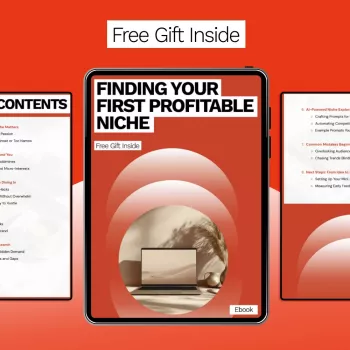
- Finding Your First Profitable Niche: The Ultimate Beginner’s Guide on How to Find a Profitable Niche for Beginners, eBook, Checklist, and Step-by-Step Strategy (great for turning your idea bank into a clear niche statement and a 30-day test plan)
- Speak Success: Your Power Words Action Checklist (useful when you’re writing a simple offer page and want clearer, more decisive messaging)
- Break Free: Stop Self-Sabotage Today (helpful if overthinking and second-guessing keep stalling your niche test)
A simple 7-day niche test plan
Common beginner mistakes that slow profitability
FAQ
How do beginners know if a niche is profitable?
Look for proof of spending: existing products or services with ongoing reviews, repeated problem language across multiple platforms, and buying signals like comparisons, pricing discussions, and recommendation requests.
Is it better to pick a niche you love or one that pays?
Prioritize a painful problem with clear willingness to pay, then choose an angle you can stick with long enough to build momentum. A strong middle ground is a paying niche where gaining expertise is realistic and the audience is easy to reach.
How narrow should a first niche be?
Narrow enough to describe the buyer and outcome in one sentence. If you need a paragraph to explain it, tighten the focus by adding a life stage, skill level, constraint, or specific goal.





Leave a comment