Find the Right Hobby Without Guessing: 7-Day Fit Plan

Choosing a Hobby Without the Guesswork
Choosing a hobby can feel oddly high-stakes: time, money, identity, and energy all get wrapped into the decision. Instead of randomly sampling activities and hoping one “clicks,” a workbook-style approach helps a hobby emerge from what you actually enjoy—how your body feels during it, how easy it is to return to, and what kind of motivation shows up once you’ve tried it for real.
The goal isn’t to find a single “forever hobby.” It’s to find a good-fit hobby for your current season of life—one that works with your energy, your environment, and your constraints.
Why guessing hobbies fails (and what to do instead)
Most hobby searches fail for predictable reasons. The most common trap is picking hobbies based on aesthetics, trends, or someone else’s personality rather than lived enjoyment. Something can look amazing on social media and still feel draining on a Tuesday night.
Another trap is the “perfect hobby” myth—expecting instant passion instead of allowing interest to build through small wins. For many people, enjoyment shows up after repetition: the second or third session is often when a hobby starts to feel like yours.
Mismatch patterns are also everywhere:
- Choosing high-social hobbies when you actually need recovery time to feel steady.
- Choosing high-gear hobbies (big setup, big adrenaline) when consistency is the real constraint.
- Choosing “productive” hobbies when what you truly need is decompression.
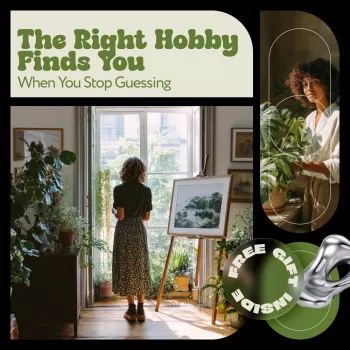
A better approach is to treat hobby-finding like self-discovery: clarify values, energy, environment, and then run a few low-pressure experiments. If you want a guided version of that process, The Right Hobby Finds You When You Stop Guessing – eBook Guide on How to Find a That Fits My Personality, Self-Discovery Workbook for Lifestyle & Creative Clarity walks you from vague interest to a short list you can actually test.
A quick personality-fit map: energy, environment, and motivation
Instead of asking, “What hobby should I do?”, try three simpler questions.
1) What energy style fits you right now?
- Restorative (calming): lowers stress, supports regulation (e.g., gentle crafting, journaling, slow walks).
- Expressive (activating): lifts mood through energy output (e.g., dance, improvisation, upbeat music-making).
- Skill-building (focused): satisfying concentration and progress (e.g., drawing practice, language study, puzzles).
2) What environment do you return to easily?
- Home-based: minimal travel, easier consistency.
- Outdoors: nature + movement; great for reset.
- Studio/third-place: a separate space helps you switch modes.
- Community/group: external structure keeps it alive.
3) What motivation actually sticks?
- Novelty-driven: you enjoy variety and fresh starts.
- Mastery-driven: you love improving one notch at a time.
- Meaning-driven: you want depth, purpose, reflection.
- Social-driven: you enjoy the people as much as the activity.
Friction check (the make-or-break factor)
| Signal | What it might mean | Next step |
|---|---|---|
| Time passes quickly | Intrinsic interest is present | Repeat the same activity twice before switching |
| You want to improve one small thing | Mastery motivation is emerging | Choose one micro-skill to practice for a week |
| You feel calmer afterward | Restorative match | Schedule it after stressful blocks or evenings |
| You talk about it unprompted | Identity resonance | Find a light community touchpoint (forum/class) |
| You avoid starting even though it sounds cool | Friction is too high right now | Reduce setup (starter kit, shorter sessions) |
Self-discovery prompts that narrow options fast
If you like tracking your answers and turning them into a clear shortlist, pairing the prompts with a structured worksheet can help: The Right Hobby Finds You When You Stop Guessing is built for exactly that decision funnel.
A 7-day “stop guessing” experiment plan
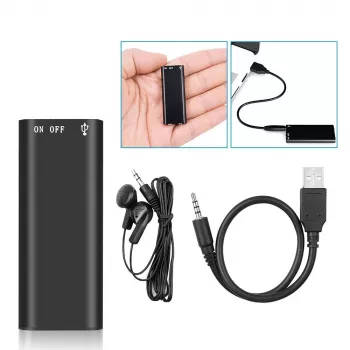
If you want a simple way to capture “after-feeling” notes hands-free (especially during walks, crafting, or movement-based trials), a small recorder can make the process effortless: Mini 8GB Voice Recorder Digital Audio MP3 Player USB Pen with Earphones.
When motivation drops: how to stay aligned without forcing it
Stress and mood are strongly affected by your daily patterns; choosing restorative or movement-based hobbies can support overall well-being. For more context, see the American Psychological Association’s overview of stress effects on the body and Harvard Health Publishing’s notes on exercising to relax.
Workbook support: a guided path to hobby-personality clarity
- For a structured hobby-fit process: The Right Hobby Finds You When You Stop Guessing turns scattered curiosity into a realistic shortlist and a low-pressure plan.
- For reducing self-sabotage loops that derail consistency: Break Free: Stop Self-Sabotage Today focuses on patterns that interrupt follow-through.
- For daily mindset cues that support showing up: Speak Success: Your Power Words Action Checklist is a quick, repeatable way to reinforce your intention without turning a hobby into a performance.
FAQ
How do I find a hobby that fits my personality if I feel like I like everything?
Filter by energy (restorative, expressive, skill-building), then by environment (home, outdoors, community), and finally by friction (setup, cost, scheduling). Run short trials and repeat the best-feeling option once to confirm it’s a fit, not just a fun idea.
What if I lose interest in every hobby after a week?
That’s often novelty wearing off, not proof you “can’t stick to anything.” Try a minimum viable 10-minute version, simplify setup, and commit to two weeks measured by sessions (not outcomes); pivot only if it consistently feels draining or misaligned.
Do I need to be good at something for it to count as a hobby?
No—many hobbies are restorative or exploratory and don’t require performance. Focus on one micro-skill at a time and track how you feel afterward and how easy it is to return, rather than how “good” you are.




Leave a comment